London Murders | 10 Rillington Place
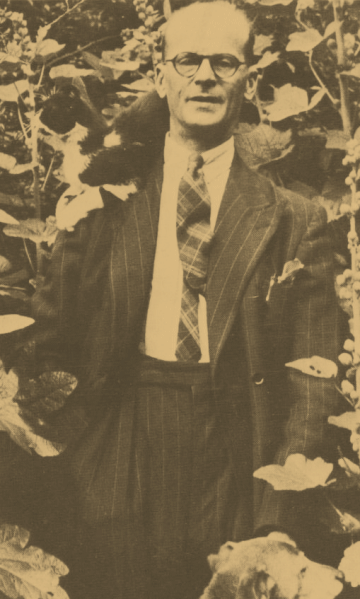
Reginald Christie doing a bit of work in the garden
10 Rillington Place is an address just as famous than the killer who occupied the house; John Reginald Halliday Christie. Christie, a Yorkshire man by birth, who fought for this country during the First World War. In 1920 he married Ethel Waddington, before leaving her just a few years later to move down south to London. He had a criminal record for committing a few petty crimes, including hitting a woman with a cricket bat. At the end of the 1930's Ethel joined him in London, where they moved into a ground floor flat at their notorious address, number 10 Rillington Place.
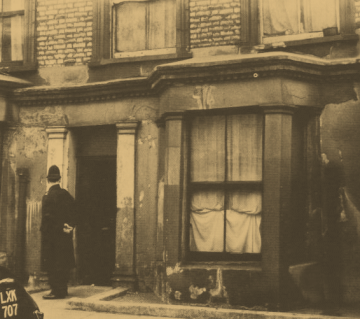
10 Rillington place with a police guard outside
During the start of the Second World War, Christie had enrolled as a special policeman at the Harrow Road police station. It was as a special policeman he took delight in apprehending prostitutes, before killing them and making love to their dead bodies.
Twice while his wife was away he took a couple of women to his home, gassed them with Friars Balsam from a jam jar with a rubber tube going into a small cardboard box, which he placed around their mouths, with a jubilee clip before releasing the gas. After the ladies pass out through being gassed, he would strangle them with a piece of cord, before making love to their dead bodies. The women on the first two occasions were Ruth Fuerst and Murial Eady, with their bodies buried in the back garden of Rillington Place.
Ruth’s skull had surfaced sometime later after Christie had taken it to a bombed out house at number 133 St Mark’s Road, where he threw it over the wall. When later discovered it was assumed to be that of a war victim, and a police inquiry was deemed unnecessary. Her thigh bone was also re-surfacing at number 10, so Christie put it to use as a support for his lose garden fence.
When the war eventually ended, the top flat of number ten was let to a Welsh van driver named Timothy John Evans, along with his wife Beryl and their young baby daughter Geraldine. Evans was an illiterate man, as well as a liar, which would be his downfall and make him useful to the cunning Mr Christie.
Christie heard a fight going on upstairs between the Evans's one morning in 1949, he discovered it was over Beryl being pregnant again, with little money from van driving, Evans was looking for a way out. Christie suggested an abortion, which he claimed he was competent enough to perform. Unfortunately for Beryl Christie gassed her using domestic gas, killing both her and the unborn child. When Evans returned from work, Christie informed him that the abortion had gone tragically wrong. When Evans wanted to report their deaths to the police, Christie said he didn't think it a good idea as they would both get done for murder. Instead, he advised Evans to visit his homeland for a few days, while Christie would dispose of Beryl down the manhole outside number ten. Evans took his advice and returned to his native Wales, looking up some of his relatives, who in turn became suspicious and called the police. Scotland Yard was informed that Evans had killed his wife, disposing of her body down the manhole cover just outside of number 10 Rillington place. A search of the area was made without finding anything, although the police did discover that Beryl and the baby were missing, so was all the furniture too. A second statement made by Evans said that Christie had done an abortion on his wife which had gone wrong and she had died as a result. he also added that Christie told him that he had put her down the manhole and that he gave their daughter to a friend in Acton to look after. Evans was returned to the Metropolitan Police at Ladbroke Grove for questioning. Soon after his arrival at the police station, his wife and the babies bodies were both discovered in a tiny wash-house in the garden of number ten.
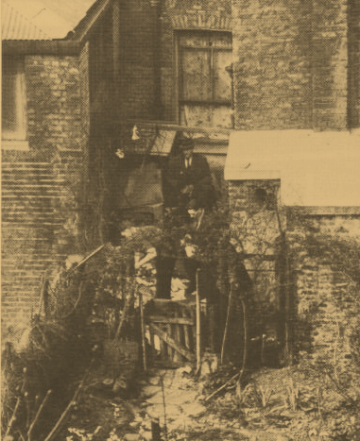
Police detectives doing a bit of digging!
It looked to everyone that Evans had killed his wife and baby and because of his compulsive lying he took any suspicion away from Christie. He made a third statement and in it, he claimed to have murdered them both. At his trial, he reverted back to accusing Christie, and by this time even his own council did not believe him. He was found guilty of both murders and was hanged at Pentonville Prison. During Christmas 1953, Christie was sending cards to his wife Ethel's friends saying she could not write herself as she had hurt her hand, adding that he would be cooking the Christmas dinner. For some reason never discovered, Christie had killed Ethel and buried her body beneath the sitting room floorboards. He would sprinkle disinfectant daily to hide any stench of the rotting body. He went to a local café, where he found another three separate ladies, taking them each in turn back to Rillington Place, strangling them each time and abusing their bodies, before dumping them in the small alcove in the kitchen. With now four badly decomposed bodies around the flat no amount of disinfectant could stop the smell. He sold off his furniture to Mr Hookway, of 319 Portobello Road, then he found a couple of West Indians to sublet from him, and with their deposits, he left without a trace.
The landlord soon found out about the subletting, shocked at the state that Christie had left his property in. The owner sold the flat to a Jamaican family, and when moving in they found one side of the kitchen wall was mere cardboard paper, after making a hole through it, they discovered a woman's body. A large police hunt was on for Christie, meanwhile, the discovery of other bodies came to light. They were identified as Kathleen Maloney, Rita Nelson and Hectorina Maclennon, all found in the alcove; Ethel under the floorboards, Ruth Fuerst and Muriel Eady in the back garden. The picture of Christie in his garden on the top of this page was front cover in every daily newspaper. A policeman found the runaway Christie on the embankment by Putney Bridge. At his trial Christie pleaded insanity, confessing to all the murders, remarking; "The more the merrier!" Christie was found guilty and also hanged at Pentonville. The Welshman Timothy Evans was given a posthumous free pardon and his body was released to family for a reburial.
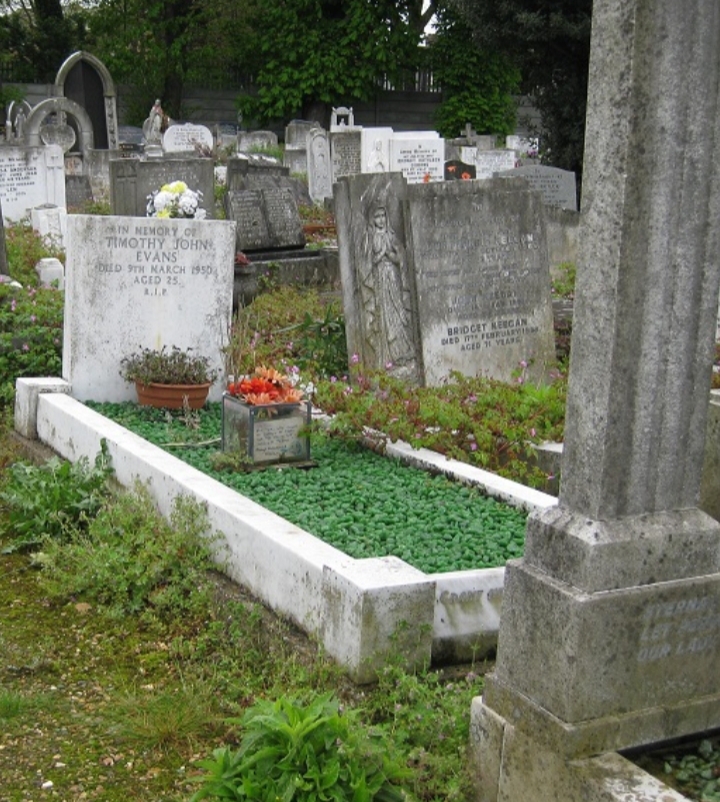
Tombstone of Timothy Evans
The final resting place of Timothy Evans is in Saint Patrick's Roman Catholic Cemetery, directly behind Leyton Underground Station, where Timothy was laid to rest in 1965, after his posthumous pardon from Pentonville Prison.
London Time

Follow Us
The contents of this website are the property of knowledgeoflondon.com and therefore must not be reproduced without permission. Every effort is made to ensure the details contained on this website are correct, however, we cannot accept responsibility for errors and omissions.
© Copyright 2004 -
Contact Us | Advertise



